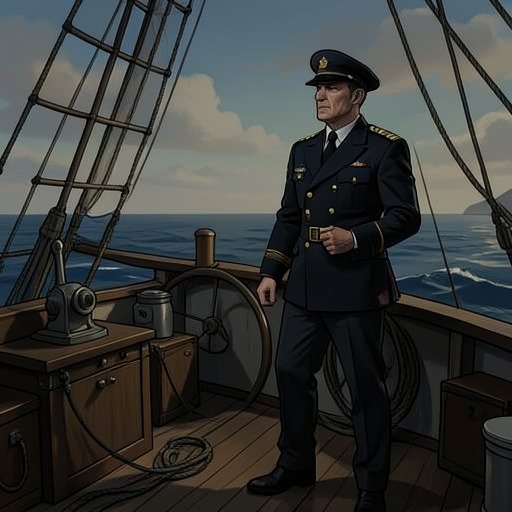
Alfred Peter Ducely
The Caine MutinyAlfred Peter Ducely is the Caine’s assistant communicator, an ensign whose persistent carelessness frustrates Willie Keith and gives Philip Francis Queeg repeated grounds to criticize the communications department. His departure from the ship brings a second, more consequential disclosure: Ducely has information about the missing-key investigation, but has kept it to himself out of sympathy for Whittaker. The novel makes him at once a source of routine professional trouble and an imperfect witness whose silence helps prolong a shipboard mystery.
Identity and Shipboard Role
Ducely serves under Willie Keith in the communications department. The evidence presents him not as a capable subordinate who occasionally errs, but as a recurring weakness in a department for which Keith is held responsible. When Queeg finds a mistake or omission, it nearly always leads back to Ducely. Keith has tried anger, contempt, appeals, and a sharp conversation in the presence of Steve Maryk, but Ducely remains as vague and slovenly as before. He promises to improve, then fails to do so; eventually, he insists that he is no good and cannot become any better.
The consequence is a lopsided professional relationship. Keith could report Ducely to Queeg for court-martial or dismissal, but refuses to identify him as the source of the department’s failings. Keith takes a belligerent pride in never blaming his assistant, even indirectly, and finds a perverse satisfaction in Ducely receiving an excellent fitness report. That restraint does not repair the work. Instead, it leaves Keith to absorb responsibility for errors he cannot reliably prevent, while Ducely escapes the direct consequences that might have followed an honest account of his performance.
Work Under Philip Francis Queeg
Ducely’s failings matter partly because Queeg scrutinizes the communications department closely. His complaints to Keith range across decoding delays, mail routing, corrected publications, a smell of coffee near the radio shack, and a signalman’s copying error. The issues vary, but Keith’s assistant remains the vulnerable point: when a concrete mistake is brought forward, it nearly always traces back to Ducely. Keith responds by becoming exceptionally thorough and accurate, trying to anticipate objections before Queeg can make them. Ducely’s unreliability thus helps drive Keith’s effort to protect his own standing, even as Keith’s refusal to expose him preserves the underlying problem.
The account also gives Ducely a recognizable pattern of retreat. His early promises to reform give way to petulant declarations of incapacity. Keith’s unsuccessful attempts to change his behavior establish that this is not a single lapse that a warning quickly corrects. Yet the narrative does not show Ducely being formally punished for these recurring failures. On the contrary, Keith’s protection of him culminates in the excellent fitness report, a favorable official assessment at odds with the private record of work problems.
The Missing-Key Investigation
When the Caine is searching for a missing key, Queeg narrows his suspicions by questioning people and testing possible explanations. He tells Maryk that the steward’s mates can be ruled out, after frightening them, and that Whittaker could not have taken the key because it was chained to his belt while he slept. These exclusions do not solve the case; they set the stage for Ducely’s late disclosure.
As he prepares to leave, Ducely tells Keith that he knows there is no key to find and describes seeing the mess boys scraping out the container at about one in the morning. He had come off the midwatch to use the head and passed the pantry while they were at it. His account provides a concrete observation relevant to the investigation, but Ducely does not present himself as someone who had promptly helped resolve it. He admits that he said nothing at the meeting because Whittaker’s distress had moved him. His silence was an act of sympathy, as he understood it, but it withheld information while suspicion and searching continued.
Departure and Character Significance
Queeg eventually detaches Ducely, and Ducely leaves the Caine for the beach in a boat from the destroyer Harte. As he packs, he is jubilant about getting off what he regards as a miserable ship. He wears dress blues bearing a new yellow ribbon and two battle stars, and packs a pigskin suitcase. His relief at leaving is accompanied by a blunt certainty that the search will find no key. He tells Keith what he knows only after securing Keith’s agreement not to disclose it until twenty minutes after he has gone.
That timing captures the contradiction in Ducely’s role. He does not openly accuse the mess boys or explain more than what he saw, and his stated reason for remaining silent is pity for Whittaker. But he also makes his departure the condition for disclosure, ensuring that he can leave the ship before his information becomes known. The character is therefore defined less by a change in conduct than by a repeated evasion of responsibility: at work, Keith shields him from blame; in the key inquiry, Ducely withholds a potentially useful observation until he is leaving. The novel’s prefatory note identifies the Caine and its people as fictional, placing Ducely within a work set against the historical setting of World War II rather than presenting him as a portrait of a real naval officer.